
Union Pacific / Norfolk Southern: The $85 Billion Conditions-Risk Trade
Investors may be watching whether the rail merger gets approved. The sharper question is whether approval comes with conditions that change the economics of the trade.

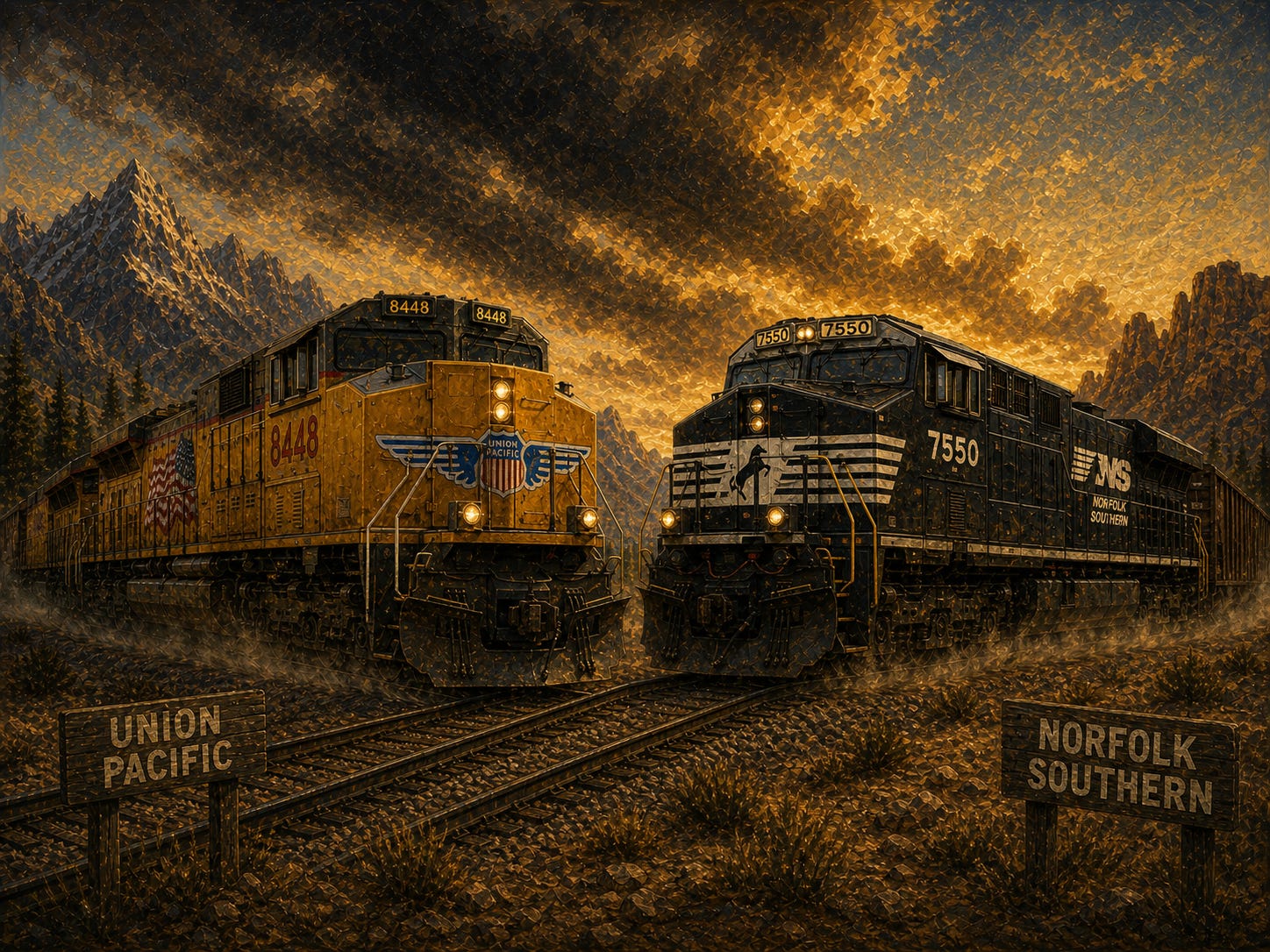
Why the real question is not whether the deal closes, but what legal permission costs
Union Pacific and Norfolk Southern are not just asking regulators to approve a railroad merger.
They are asking the Surface Transportation Board to accept a theory of scale.
That is the central risk in the transaction, which has been reported at roughly $85 billion. The companies are arguing that a national rail network can lower friction, improve service, shift freight from trucks to rail, and benefit shippers. Opponents are arguing that the same network could reduce shipper leverage, raise costs, and give the combined railroad too much market power.
For investors, the question is not simply whether the deal closes.
The question is whether it closes in a form that preserves the upside.
The Filing That Restarted the Clock
Union Pacific and Norfolk Southern submitted a revised major merger application to the Surface Transportation Board on April 30, 2026. The deal would combine Union Pacific’s western network with Norfolk Southern’s eastern network, creating what the companies describe as the first U.S. coast-to-coast freight rail operator.
The revised filing followed the STB’s earlier finding that the original application was incomplete. That earlier decision did not reject the deal on the merits. It rejected the application as incomplete, which means the companies were allowed to refile.
That procedural distinction matters.
The Board’s concern was not clerical. The missing information included forward-looking market-share projections and competitive-impact analysis. Those details go directly to the question at the center of the merger: what happens to freight competition after the networks combine?
The STB has invited comments on whether the revised application is complete. Comments are due May 8, 2026, and the applicants’ replies are due May 12, 2026.
Why Investors Should Care
This is not only a regulatory story. It affects the economics of the trade.
Norfolk Southern holders care because the spread depends on whether the transaction is approved, delayed, conditioned, or rejected. Union Pacific holders care because approval alone does not determine value. The value depends on how much of the promised network benefit survives the STB’s conditions.
The key investor question is therefore not simply:
Will the deal close?
It is:
Will the deal close in a form that preserves the economic upside?
Delay is also part of the economics. A prolonged review affects carry, deal-spread behavior, integration timing, and how long investors must underwrite the synergy case without regulatory certainty.
That is the difference between legal approval and market consequence.
The Real Test: Efficiency or Leverage
The obvious question is whether regulators will approve the deal.
The better question is whether regulators accept the companies’ economic story.
Union Pacific and Norfolk Southern are presenting the transaction as a national network upgrade. Their case is that a combined railroad would reduce handoffs, simplify routing, improve reliability, shift freight from trucks to rail, and lower costs for shippers. The companies estimate $3.5 billion in annual shipper savings, the removal of roughly 2.1 million trucks from roads, and about 1,200 new union jobs within three years.
That is the approval story.
The opposition story is different. Critics argue that the merger could reduce competition, raise shipping costs, harm service quality, and give the combined railroad more leverage over customers with limited alternatives. A coalition including business groups, rival railroads, and labor unions has publicly opposed the transaction.
This is not just a railroad merger.
It is a test of whether scale gets treated as public-benefit infrastructure or market power with better language.
The core variable is simple:
Does the STB treat this as efficiency-enhancing scale or competition-reducing concentration?
That is the entire case.
One side says the merger eliminates costly handoffs, reduces delays, shifts freight from trucks to rail, saves shippers money, and creates public benefits.
The other side says the same scale could reduce shipper leverage, raise rates, weaken service accountability, and pressure the rest of the rail market into further consolidation.
This is why the legal process matters to the investment case. The STB is not just deciding whether Union Pacific can buy Norfolk Southern. It is deciding how much of the combined company’s economic theory survives regulatory review.
Why This Rail Deal Is Different
This deal is harder than an ordinary corporate merger because the STB is not only reviewing antitrust harm.
It is reviewing the structure of a national freight system.
Union Pacific is strongest in the western United States. Norfolk Southern is strongest in the eastern United States. The companies will argue that this is an end-to-end combination, not a direct overlap merger. That helps them because they can say the deal connects networks rather than eliminating head-to-head competition.
That argument has force.
It does not solve the problem.
A national rail network can create efficiency and leverage at the same time. The same structure that reduces interchange friction can also reduce a shipper’s ability to play carriers against each other.
This is why ordinary merger language can mislead investors. The STB is not merely asking whether competition is harmed. Under the tougher post-2001 major rail merger framework, the applicants must show that the transaction enhances competition and serves the public interest.
That makes the review unusually important.
The companies’ end-to-end argument may reduce overlap concerns. It does not eliminate the need to prove that the combination improves the rail system enough to justify the new market structure.
The Legal Traps Inside the Deal
Several issues complicate the investment read.
First, the deal value may be quoted differently across sources. Some coverage describes the transaction as an $85 billion tie-up. Other outlets may frame deal value differently depending on whether they emphasize equity value, enterprise value, or transaction value. The cleaner phrasing is “reported at roughly $85 billion.”
Second, labor should not be treated as solved. The companies point to job security and projected union-job creation, but labor groups are also among the opponents cited in public reporting. Labor may still matter through safety, staffing, service, and bargaining concerns.
Third, environmental and public-interest claims can cut both ways. The truck-to-rail claim gives the companies a strong public-benefit narrative. The legal question is whether the STB treats that benefit as measurable, merger-specific, and sufficient to offset competitive concerns.
Fourth, political support does not control the record. Political support may affect the atmosphere around the deal. It does not replace the Board’s statutory analysis.
These are not side issues. They are the places where deal optimism can get converted into conditions, delay, or a narrower economic result.
The Call: Approval, But Not Clean Approval
Approval is more likely than outright rejection, but clean approval is unlikely.
The companies have a plausible public-benefit story. A coast-to-coast rail network is easy to understand. The efficiency claims are concrete. The companies can point to reduced handoffs, truck-to-rail conversion, shipper savings, job commitments, and supply-chain benefits.
That is a stronger approval record than a merger justified only by cost cuts.
The problem is the standard.
This is not a normal corporate merger where avoiding obvious overlap problems may be enough. This is a major rail transaction under a framework that requires an affirmative showing of enhanced competition and public-interest benefits.
That makes bare approval less likely.
The more probable path is approval with conditions designed to protect shippers, preserve access, monitor service, and limit abuse of network leverage. Those conditions could include access commitments, service-monitoring obligations, reciprocal-switching protections, rate-related safeguards, targeted divestitures, reporting requirements, or other shipper-protection terms.
For investors, that means the key question is not only whether the deal closes. It is how much of the promised economic upside survives the conditions.
This is likely less of a pure approval/rejection trade and more of a conditions-risk trade.
What Could Break The Call
The less likely outcome is that the STB rejects the deal or imposes conditions so heavy that the economics deteriorate.
That would mean the Board sees the merger as a structural threat to freight competition rather than a public-benefit network upgrade. It would also signal that future Class I rail consolidation is much harder than investors hoped.
That outcome would not just affect Union Pacific and Norfolk Southern. It would likely reset expectations for future Class I rail consolidation.
The call would also weaken if the STB’s review begins to focus less on operational efficiency and more on market-share shifts, shipper alternatives, reciprocal switching, access commitments, traffic diversion, and rate leverage.
Those are the signals that the Board may be moving from efficiency review toward structural skepticism.
What to Watch Next
The next signal is not only whether the STB accepts the revised application as complete.
The more important signal is the kind of questions the Board asks once the review moves forward.
Questions about shipper savings, service reliability, interchange efficiency, truck-to-rail conversion, and job commitments favor the companies’ efficiency story.
Questions about market-share shifts, traffic diversion, shipper alternatives, reciprocal switching, access commitments, service monitoring, rate leverage, or divestitures favor the opposition’s concentration story.
Also watch whether the discussion moves from broad public benefits to specific remedies. Once the debate shifts to access, switching, rate leverage, service monitoring, or divestitures, the market should stop treating approval as the only question.
That is where the trade will start to sharpen.
The Investor Takeaway
The market should not treat this as a simple approval trade.
Union Pacific and Norfolk Southern are not just asking regulators to approve a merger.
They are asking regulators to accept a theory of scale.
A conditioned approval may still close the deal. The real issue is whether the approval order preserves the economics that made the deal worth pursuing in the first place.
For investors, the question is not whether regulators open the gate.
It is what the companies have to give up to walk through it.
Disclaimer: The Capital Case is for informational and analytical purposes only. Nothing here is legal, financial, or investment advice, and nothing should be read as a recommendation to buy, sell, hold, or trade any security. Readers should conduct their own diligence and consult qualified advisors before making legal or investment decisions.