
Case Brief: Boeing and the Lawsuit Hidden Inside the Turnaround Story
This is not just a case about Boeing’s safety failures. It is about what happens when a company tells the market it has fixed the problem, and the next failure suggests otherwise.

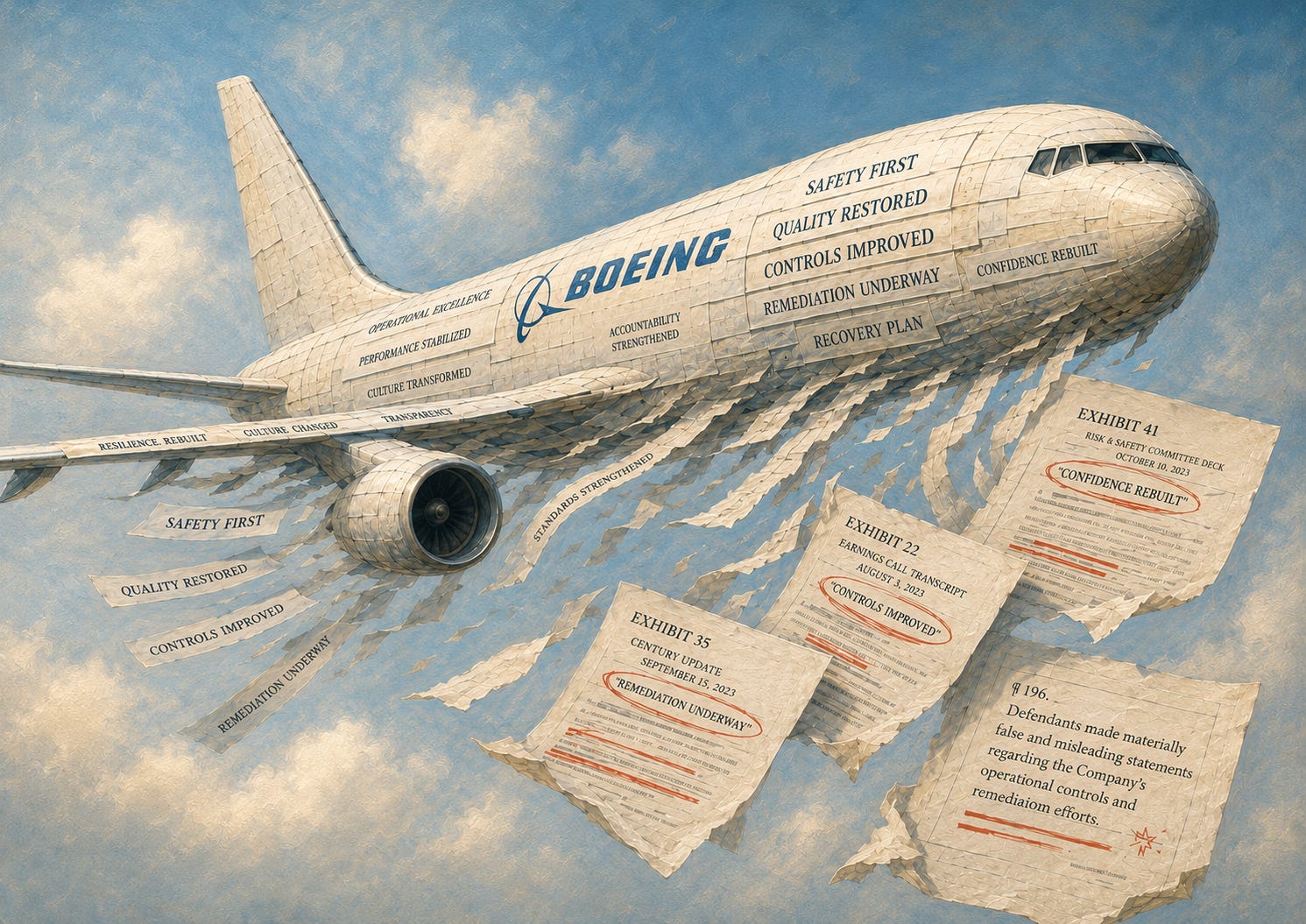
Boeing is already facing the obvious legal and regulatory fallout from years of safety and quality failures.
The company’s backdrop includes its DOJ deferred-prosecution history, later DOJ findings that Boeing breached that agreement, the Alaska Airlines door-plug incident, FAA quality-control scrutiny, and the continuing oversight that follows a company after this many public failures.
This brief is about a different piece of the legal stack: the investor lawsuit.
Shareholders have sued Boeing under the securities laws, arguing that the company misled the market through public statements about safety, quality, and reform. Their claim is not simply that Boeing built flawed planes or had terrible internal problems. Securities law usually requires a missing step. Plaintiffs must connect the business failure to something the company told the market.
That is where the securities case becomes more interesting.
Boeing did not just have to fix planes after the MAX crashes and later safety incidents. It had to restore confidence. It had to tell regulators, airlines, passengers, employees, and investors that safety and quality were being addressed. That kind of language is unavoidable after a crisis. It is also dangerous because the market may start pricing the recovery before the recovery is fully proven.
Shareholders say those reassurances did more than calm nerves. They allegedly helped support the stock price by making investors believe the company’s safety and quality problems were under better control than they really were. When later failures emerged, plaintiffs argue the stock was not just reacting to new bad news. It was correcting an earlier repair story that had been too optimistic.
The current fight is about class certification.
That sounds procedural. It is not. Certification is the stage where this kind of securities case can stop being an overhang and become real settlement leverage.
Boeing, as defendant, says plaintiffs cannot simply gather years of safety and quality statements, point to later stock drops, and say the damages can be worked out later. At certification, the company argues plaintiffs need a workable way to measure how much inflation was allegedly in the stock price, on which dates, and from which statements. That damages-methodology fight is the issue highlighted by SIFMA’s amicus brief and by securities-litigation commentary tracking Boeing alongside other class-certification cases.
The more likely path is not that Boeing makes this litigation theory disappear. The more likely path is narrower: the company may force courts to demand more discipline before a messy operational failure becomes a certified securities class action.
That is still important.
The appeal is not merely about Boeing.
It is about how easily a corporate crisis can be converted into securities leverage.
The old version of a stock-drop case was cleaner. A company said something specific. The statement was false. The truth came out. The stock dropped. Plaintiffs sued.
The newer version is more subtle. A company suffers a crisis. Management then sells a repair story to the market. Safety is now the priority. Compliance has improved. Quality controls have been strengthened. The organization has learned its lesson.
Then another failure happens.
Here, plaintiffs do not need to prove that the second failure is identical to the first one. They argue that the second failure revealed the repair story was inflated all along.
That’s the new strategy.
A troubled company trades partly on whether the market believes the turnaround. A regulated company trades partly on whether the market believes the compliance fix. An industrial company trades partly on whether the market believes quality control has been restored.
Those assurances are not just public relations. In many cases, they are part of the valuation.
The plaintiffs’ bar has found a powerful pattern. Take the original failure. Track the company’s repair language. Wait for the next event. Then argue that the market was not merely disappointed by new bad news. It was correcting earlier overconfidence.
The legal issue is whether courts will make plaintiffs prove that connection with more discipline before they get the leverage of a certified class.
Boeing wants the court to say yes.
The shareholders want the court to say that traditional securities damages methods are enough at this stage. Their position is that securities cases have long used an out-of-pocket damages model: investors bought at an inflated price, the truth emerged, and the inflation can be measured using common evidence.
That is not a weak argument. Securities class actions exist because public markets price information collectively. If every investor had to prove individualized reliance and individualized damages from scratch, most securities cases would collapse before they started.
The problem is fit.
The securities case is not built around one clean statement on one clean date that caused one clean stock drop. It involves many statements over time about safety and quality, public information that evolved throughout the period, and a later operational failure that allegedly revealed the truth. That makes the damages theory more fragile.
If the stock was inflated, how much was it inflated in 2021 versus 2022 versus 2023? Did each repeated safety statement add more inflation, maintain existing inflation, or do nothing? Did public reports about Boeing’s problems reduce inflation along the way? Did the Alaska Airlines incident reveal hidden fraud, materialize an already known operational risk, or do some mixture of both?
Those details sound technical until you remember what class certification does.
It turns uncertainty into settlement pressure.
That is the real fight in the appeal. Not whether Boeing is a flawless defendant. It is not. Not whether the plaintiffs have serious facts. They do. The fight is whether appellate courts are willing to force more rigor at the certification stage before a complicated operational failure becomes a massive securities class action.
The more probable path is that Boeing gets some help on damages methodology without getting a clean escape from the theory itself. Courts may be increasingly uncomfortable with allowing plaintiffs to invoke a general damages formula and postpone the harder work of matching the damages model to the actual liability theory.
That would not kill every crisis-related securities case. It would make the conversion harder.
A Boeing win would not mean companies can say whatever they want after a crisis. It would mean plaintiffs need more than a later accident and a folder full of reassuring statements. They would need a damages model that actually follows their theory.
A Boeing loss would tell the market something different. It would suggest that broad post-crisis reform language remains dangerous even when the damages theory is complicated. That would strengthen the plaintiffs’ playbook against companies whose valuation depends on trust repair.
Why Investors Should Care
The ordinary way to read Boeing is operational. Are planes being delivered? Are regulators satisfied? Is production improving? Is management credible?
All of that matters, but the legal exposure sits somewhere else: in the language Boeing used to sell the repair.
That is the part ordinary coverage tends to miss.
A complaint is not always a valuation event. Class certification often is. Investors who wait until settlement headlines appear are usually late because the leverage has already shifted. The certification fight is where a case can move from legal overhang to claims-paying pressure.
This is not a Boeing buy-or-sell note. It is a way to think about crisis companies whose valuation depends on the market believing that the fix is working.
After a major failure, the market usually focuses on operations. Are deliveries improving? Are regulators backing off? Are customers staying? Are margins recoverable?
Plaintiffs look at a different record.
They look at what management said while the company was asking the market to believe in the recovery.
If the stock begins to recover because investors believe the fix is working, the repair story itself can become legally valuable.
That is the repair premium.
After a crisis, the market often gives a company credit for fixing the problem. That credit can show up in the multiple, the recovery trade, the analyst narrative, or the willingness to look past ugly facts. The question is whether the company merely acknowledged the problem, or whether it sold the market a repair story strong enough to support valuation.
That distinction matters.
A company saying “we take safety seriously” is one thing. A company saying controls have improved, audits confirm progress, remediation is working, production quality has stabilized, or known risks have been reduced is doing something different. It is not just calming the market. It is giving the market a reason to reprice the business.
Three questions matter.
How specific was the repair story? Vague culture language is harder to sue over. Statements about systems, audits, controls, remediation, risk reduction, or production improvements are more dangerous.
Did the valuation depend on the repair being believed? The more the stock trades on the idea that the worst is behind the company, the more valuable the repair story becomes to plaintiffs if the next failure hits.
Did the later event merely create new bad news, or did it contradict the claimed fix? That is the conversion point. Plaintiffs do not just want a bad event. They want a bad event that makes the earlier reassurance look inflated.
The point is not to read every corporate apology as fraud. The point is to identify when a company’s recovery narrative has become legally load-bearing.
That applies beyond aerospace. A bank after a compliance scandal. A pharma company after a safety signal. An industrial company after quality failures.
The pattern is the same. The market prices the fix. Plaintiffs later test whether the fix was real.
The Boeing case is not asking whether bad operations can hurt shareholders. Of course they can.
It asks something more uncomfortable.
When management sells the market a story of repair, and the next failure proves the repair was incomplete, is that a business disappointment or securities fraud?
The next time a crisis company says the worst is behind it, investors should not only ask whether the statement is credible.
They should ask whether the company just created the next plaintiff exhibit.